
Bénéficiez de toutes les fonctionnalités d’un CDN moderne : une scalabilité transparente, une sécurité intégrée, un contrôle par programmation et une visibilité totale.



Diffuser une finale de Coupe du monde résiliente
Comment diffuser la Coupe du monde pour environ 1,8 milliard de fans ? Découvrez-en plus sur les informations de Fastly sur le trafic, les pics de spectateurs pendant les prolongations et les stratégies de lutte contre le piratage en temps réel.


La Coupe du monde 2026 est terminée ! Félicitations à l'Espagne pour sa victoire palpitante en prolongations face à l'Argentine. Au-delà du spectacle sur le terrain et du match lui-même, livrer une diffusion de haute qualité à 1,8 milliard de personnes attendues dans le monde entier nécessite une attention particulière portée à la résilience, aux performances et à la flexibilité du système. Lors des grands événements mondiaux en direct, la plateforme Edge Cloud de Fastly accompagne régulièrement les réseaux de diffusion, les fournisseurs OTT et les éditeurs numériques afin de maintenir l'intégrité des flux lors de pics de trafic massifs et soudains.
Mais offrir une excellente diffusion en direct nécessite bien plus que l'échelle et la vitesse exceptionnelles dont nous tirons notre nom. Cela nécessite une intelligence approfondie pour sécuriser et protéger ces diffusions contre le piratage de compte, les attaques DDoS et le piratage. Ces menaces existent depuis l'invention d'Internet, mais l'ère actuelle de l'IA modifie la forme et la complexité de ces attaques. Heureusement pour nos clients, nous faisons également évoluer continuellement nos recherches et nos produits afin de les détecter et de les atténuer de manière proactive.
Atténuation du piratage et des menaces de bots automatisés en périphérie
Pendant les événements sportifs en direct à fort trafic, nous collaborons étroitement avec nos clients pour faire face au piratage du streaming en direct en périphérie, en bloquant les menaces de manière dynamique et en temps réel tout au long de la diffusion.
En analysant plusieurs signaux dans chaque requête, des empreintes numériques du client à la provenance du trafic, nous pouvons distinguer les spectateurs légitimes des spectateurs malveillants, les scrapers et les botnets. Cela inclut les acteurs malveillants qui tentent de se faire passer pour des joueurs ou des navigateurs de confiance. Nous aidons également nos clients à sécuriser le chemin de distribution lui-même, afin que l'infrastructure interne ne puisse pas être exploitée comme une porte dérobée vers du contenu premium.
Ces efforts associent la technologie, l'expertise des opérateurs et une réponse conjointe en temps réel pour créer une stratégie de défense en profondeur à plusieurs niveaux qui augmente le coût du piratage sans ajouter de friction pour les vrais fans. Nous avons déjà écrit sur notre travail par le passé, mais cette pratique est un effort de recherche continu pour nos équipes d'ingénierie et nos équipes clients.
Le résultat, dans le cas de la Coupe du monde, a été un ensemble d'expériences incroyables lors des quarts de finale, demi-finales, du match pour la troisième place et de la finale pour les clients et les 1,8 milliard de spectateurs attendus. Penchons-nous sur nos résultats concernant ces matchs sur notre plateforme. Pour les personnes les plus curieuses, les données tout au long de cette série représentent, sauf indication contraire, un minuscule échantillon du trafic sur notre plateforme mondiale lors de chaque match.
Finale de la Coupe du monde 2026 : analyse des pics de trafic
Comme prévu, l'audience de la finale de la Coupe du monde a été plus élevée que celle du match pour la troisième place (ainsi que des diffusions précédentes). En finale, les enjeux sont extrêmement élevés et les équipes donnent leur maximum. Les supporters le savent et se connectent en conséquence. Cependant, le match pour la troisième place opposait toujours deux équipes d'élite avec des communautés de supporters passionnés qui génèrent une audience significative. Alors, à quel point étaient-ils proches ?
Lorsque nous avons observé l'évolution des données, la différence était considérable : la finale entre l'Espagne et l'Argentine a généré près du double du trafic du match pour la troisième place entre l'Angleterre et la France, si l'on compare les pics de spectateurs. Rien dans nos données n'indique que les spectateurs qui ont regardé le match pour la troisième place étaient de « plus vrais supporters » que ceux qui ont seulement regardé la finale, nous laissons donc cette classification en exercice pour le lecteur.
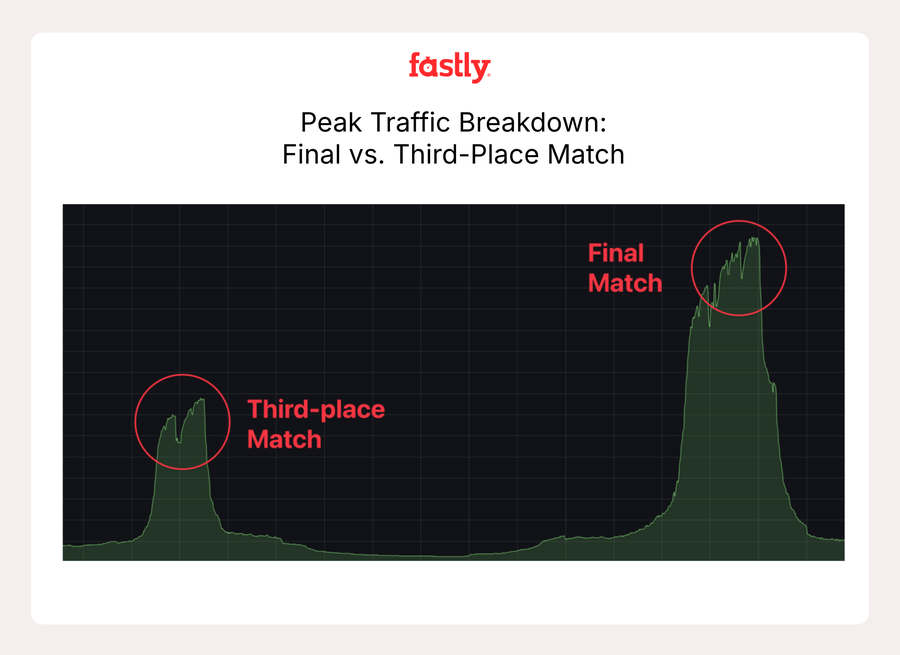
Sans surprise, la finale de la Coupe du monde a enregistré l'audience la plus élevée du tournoi, selon nos données. De plus, le fait que le match de la finale ait enregistré près de deux fois plus de trafic que le match pour la troisième place était attendu.
Ce à quoi nous ne nous attendions pas, c'est que, alors que la finale partait en prolongations, la croissance de l'audience s'est poursuivie sur le même schéma que celui que nous avons observé tout au long de cette compétition. Nous avions supposé que la finale de la Coupe du monde aurait déjà atteint son niveau d'audience maximal au milieu du match, mais des éléments montrent qu'il existe encore une demande non satisfaite pour le championnat le plus prestigieux du football mondial.
Comment Knockout Stakes favorise la fidélisation de l'audience
Même s'ils n'ont pas généré les chiffres d'audience totaux ni égalé le prestige de la finale, examinons les quarts de finale et les demi-finales. Bien qu'il y ait eu moins de matchs lors de ces deux phases que lors des tours à élimination directe précédents, sans parler du nombre de matchs de la plus grande phase de groupes jamais organisée, les données ont tout de même livré des informations intéressantes.
Pour les quarts de finale, l'écart-type du pic d'audience pour la seconde période des matchs était nettement inférieur à celui des huitièmes de finale. Plus précisément, l'écart-type était d'environ 15 % pour les quarts de finale, contre 25 % pour les huitièmes de finale. Nous pouvons en conclure que lorsque les enjeux sont plus élevés, les spectateurs continuent d'utiliser leurs dispositifs tout au long du match.
Autre tendance des données à cet effet : à chaque étape du tournoi et jusqu'aux quarts de finale, l'audience à la mi-temps a augmenté progressivement. Les taux moyens de déconnexion pendant la mi-temps étaient de : 24,65 % pendant la phase de groupes, 22,78 % en 16es de finale, 22,55 % en 8es de finale et 20,15 % en quarts de finale. Nous l'avons déjà dit au cours de cette série, mais les données continuent de confirmer que le football à enjeux élevés génère une audience plus importante et plus régulière. Même pendant les pauses de la mi-temps.
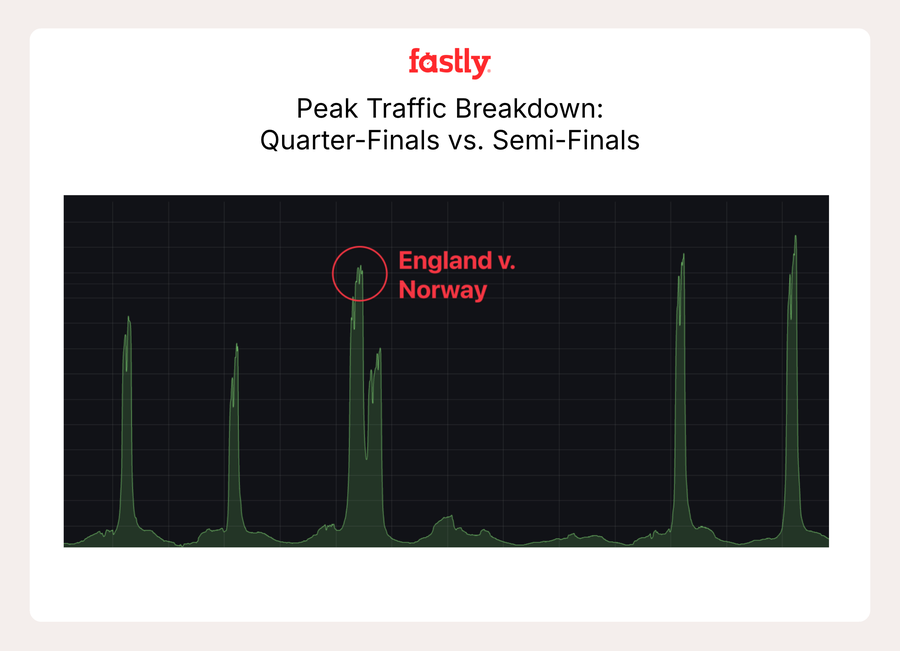
En prenant du recul, lorsque l'on compare côte à côte les quarts de finale et les demi-finales, des tendances claires émergent en matière d'audience. Si les demi-finales ont généré un volume d'audience supérieur à celui des tours précédents, un quart de finale constituait une anomalie : Angleterre-Norvège. Lors de ce match, la Norvège, outsider, a semblé un temps capable de créer l'exploit en poussant l'Angleterre en prolongations avant que cette dernière ne finisse par décrocher la victoire. C'était un autre exemple de match à enjeux élevés à égalité à la fin du temps réglementaire ayant entraîné un pic d'audience.
Mettre à l'échelle et sécuriser son prochain événement de streaming
Lorsque les enjeux sont les plus élevés, les plateformes doivent être à la hauteur. La Coupe du monde, peut-être plus que tout autre événement, exige l'excellence. Chaque image de chaque match compte, car le monde entier regarde. Accompagner avec succès nos clients tout au long de la période du tournoi a exigé une combinaison d'innovation technologique, de préparation rigoureuse et de partenariat étroit pour atteindre leurs objectifs.
Que vous vous prépariez pour de grands événements sportifs en direct, des lancements de produits mondiaux ou d'autres événements de streaming en direct, l'edge network haute performance de Fastly est conçu pour gérer les pics de trafic sans compromettre la sécurité. Si vous êtes responsable de la mise à l'échelle des systèmes et des expériences client pour lesquels les performances comptent, chaque seconde compte et la sécurité est non négociable, nous sommes prêts à vous accompagner ! Lorsque des millions de personnes se connectent, chaque milliseconde compte. Échangez dès aujourd'hui avec un expert Fastly pour vous assurer que votre réseau est rapide, résilient et sécurisé avant votre prochain pic de trafic.