

Bénéficiez de toutes les fonctionnalités d’un CDN moderne : une scalabilité transparente, une sécurité intégrée, un contrôle par programmation et une visibilité totale.




Le stade invisible
Découvrez comment l’IA, le routage en périphérie et des équipes d’experts gèrent les pics de trafic massifs pendant la Coupe du monde, garantissant ainsi une expérience de visionnage fluide et performante.



Au cœur de l’infrastructure de périphérie, des hommes et de l’IA derrière la Coupe du monde
Lorsqu’environ 1,8 milliard de personnes se connectent pour suivre un seul match, comme ce fut le cas lors du dernier match de la Coupe du monde, tout Internet se réorganise autour d’elles.
Le trafic sur notre réseau a connu un pic pendant la finale. Ce qui a particulièrement retenu notre attention, c’est la manière dont le trafic entre des catégories sans rapport entre elles s’est inversé en temps réel.
Le trafic lié aux jeux vidéo a chuté de 18 à 20 % par rapport au niveau de référence, des millions de personnes ayant posé leur manette. Dans le même temps, le trafic sur les réseaux sociaux a bondi d’environ 25 %, générant de brusques micro-pics qui coïncidaient à la seconde près avec chaque moment marquant, du carton rouge d’Enzo Fernández au but de Ferran Torres. Puis, dans les 45 minutes qui ont suivi le coup de sifflet final, le niveau de référence du réseau mondial est revenu immédiatement à la normale.
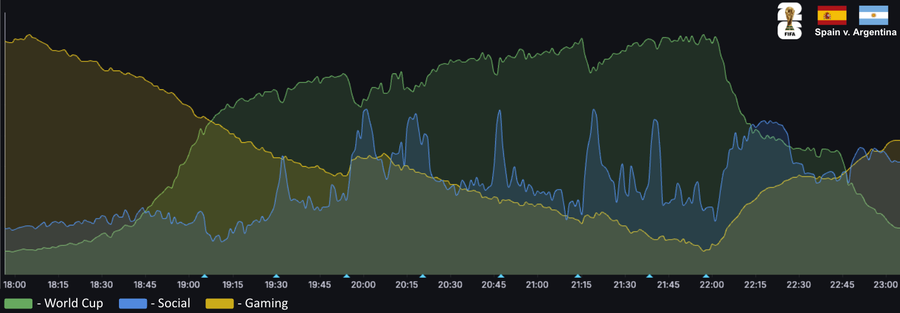
Remarque : les données ont été indexées à des fins de visualisation. Le trafic par catégorie est affiché à l’échelle.
D’après les données télémétriques, la courbe verte montre que le trafic de streaming lié à la Coupe du monde augmente progressivement avant le coup d’envoi et se maintient à un niveau élevé tout au long du match. Exactement au même moment, le trafic lié aux jeux vidéos (jaune) diminue régulièrement en proportion directe. Mais le signal le plus volatil est celui du trafic sur les réseaux sociaux (en bleu), qui connaît des pics marqués aux moments les plus importants du match.
Des pics d’affluence liés à un seul match à l’échelle d’un tournoi
Au cours de ces 39 jours et de ces 104 matchs, le tournoi est passé d’un niveau stable de 12 heures par jour à des pics mondiaux marqués par une concentration extrême, qui ont atteint un sommet cumulé considérable lors de la finale.
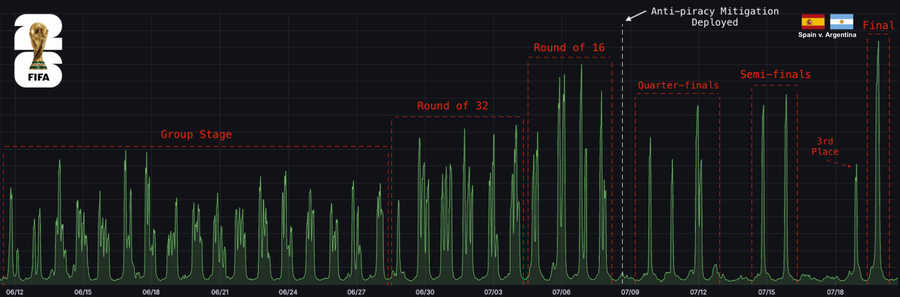
Le fait d’avoir assuré des performances ininterrompues, sans aucune panne, lors de cet événement majeur n’est pas le fruit du hasard : c’est le résultat d’une conception minutieuse. Cela a nécessité une planification prédictive des capacités, un routage autonome en périphérie avec sécurité intégrée, et des efforts d’ingénierie humaine dédiés sur les ponts de communication en direct.
Télémétrie prédictive et planification des capacités
La préparation d’un événement de cette envergure commence plusieurs mois avant son lancement. Lorsque les clients des services de streaming, des médias et des plateformes sont confrontés à des pics de trafic simultanés, l’allocation des capacités devient cruciale. Afin d’élaborer une feuille de route pour l’infrastructure mondiale, nos équipes travaillent en étroite collaboration avec les clients plusieurs mois à l’avance pour établir des prévisions de bande passante et définir les besoins régionaux en matière d’infrastructure.
Nous utilisons des modèles de machine learning pour nous aider à prendre des décisions en matière de planification des capacités. En collectant et en synthétisant d’énormes flux de données réseau en temps réel et historiques, nos outils de modélisation basés sur l’IA offrent aux équipes d’ingénierie une visibilité plus rapide et plus précise sur la demande de trafic régionale, tout en laissant aux opérateurs expérimentés le contrôle total des décisions architecturales.
Au cours de la phase de sélection, par exemple, nos modèles de télémétrie ont signalé un pic inattendu d’audience. Les outils ont immédiatement prévu les ajustements nécessaires de la topologie régionale, ce qui a permis à nos équipes chargées de l’infrastructure d’accélérer les déploiements localisés. En l’espace de quelques jours seulement, nous sommes passés des premières alertes de télémétrie à la répartition du trafic en temps réel.
Routage et sécurité autonomes en périphérie
Si les modèles prédictifs permettent de gérer la planification des capacités, le streaming en direct nécessite une exécution en moins d’une seconde au niveau de la périphérie.
Au cours du tournoi, notre réseau sous-jacent a pris des millions de décisions de routage autonomes et instantanées par seconde. Des systèmes comme Autopilot et Precision Path évaluaient en permanence l’état des opérateurs de réseaux et les performances de l’infrastructure principale, en effectuant automatiquement, en moins d’une milliseconde, des réacheminements pour contourner les goulots d’étranglement en amont.
Parallèlement, les événements sportifs en direct attirent un volume important d’activités malveillantes, notamment le piratage automatisé de flux vidéo, le bourrage d’identifiants, les tentatives de piratage de compte et les attaques DDoS volumétriques. Sous l’impulsion de l’essor des outils d’intelligence artificielle, ces menaces gagnent en rapidité et en sophistication. La performance et la sécurité étant indissociables à cette échelle, Fastly agit comme première ligne de défense, en mettant directement à disposition, à la périphérie du réseau, son expertise approfondie en matière de lutte contre la fraude et le piratage.
Au milieu du tournoi, nos équipes ont mis en place des mesures de lutte contre le piratage directement sur l’ensemble des canaux de streaming en direct. Grâce à notre Adaptive Threat Engine et à des outils tels que ContentGuard, notre plateforme a activement filtré les flux de diffusion non autorisés en temps réel, en périphérie, sans ajouter de latence pour les spectateurs légitimes ni surcharger les serveurs d’origine de nos clients.
Des personnes dévouées en direct
Quelle que soit la sophistication des systèmes de routage automatisé ou des outils utilisés, les infrastructures à enjeux élevés nécessitent une expertise sur le terrain.
L’une des valeurs fondamentales de Fastly est d’agir comme un prolongement direct des équipes et des technologies de nos clients. Tout au long des 104 matchs, nos équipes d’ingénierie ont maintenu des liaisons en direct dédiées et partagées avec les responsables techniques de nos clients. Cette démarche s’est appuyée sur plusieurs mois de préparation en amont, durant lesquels nous avons élaboré des guides d’intervention communs, mis en place des tableaux de bord d’observabilité partagés et mené des simulations parallèles de scénarios de défaillance. Les équipes de Fastly et celles de nos clients ont exploité des données de télémétrie identiques en temps réel, surveillant les paramètres de performance partagés pendant les matchs afin de détecter et de résoudre les goulots d’étranglement potentiels avant qu’ils n’aient un impact sur les utilisateurs finaux.
L’organisation du tournoi ne consistait pas en un événement unique, mais en la mise en œuvre de centaines de micro-événements, avec le soutien d’équipes expérimentées disposant d’outils performants.
Renforcer la résilience face aux pics de trafic
La Coupe du monde n’a lieu que tous les quatre ans, mais la gestion des pics de trafic en temps réel, des menaces pour la sécurité et du routage en moins d’une seconde ne se limite pas aux grands événements sportifs. C’est ce que toute infrastructure moderne doit être capable de faire au quotidien.
Lorsque la technologie est conçue pour gérer ce type d’échelle mondiale sans perte de données ni interruption de service pour les clients, ces modèles de résilience deviennent la norme de référence pour l’ensemble de la plateforme. L’objectif ultime est de rendre l’infrastructure invisible, afin que l’expérience soit la seule chose dont les spectateurs se souviennent.
Vous prévoyez votre prochain pic de trafic ? Contactez l’équipe Fastly pour en savoir plus sur la façon dont nous pouvons vous aider.