

Bénéficiez de toutes les fonctionnalités d’un CDN moderne : une scalabilité transparente, une sécurité intégrée, un contrôle par programmation et une visibilité totale.




Le secteur de l’édition à l’ère de l’IA : pourquoi la stratégie des bots est désormais une stratégie commerciale
Près de la moitié du trafic internet est désormais constituée de bots. Découvrez comment l’IA oblige les éditeurs à repenser le trafic, la visibilité et l’avenir de leur activité.


Les éditeurs ont passé des années à optimiser le trafic de recherche et des réseaux sociaux. Maintenant, ils sont contraints d’optimiser pour les bots d’IA.
Le dernier Threat Insights Report de Fastly, IA, bots et l’avenir agentique du Web, explore comment l’IA, les bots et l’automatisation remodèlent internet – et a révélé que près de la moitié de toutes les requêtes internet proviennent désormais de bots. L’un des enseignements les plus clairs du rapport est que chaque secteur connaît l’IA différemment. Certains constatent davantage d’automatisation malveillante. D’autres font face à de nouveaux défis opérationnels et d’infrastructure, tandis que des bots « recherchés » comme l’IA modifient complètement leur modèle opérationnel.
Mais pour les éditeurs, l’IA n’est pas un simple autre changement de trafic : elle impose de repenser l’échange fondamental sur lequel l’édition sur internet s’appuie depuis des années : les éditeurs créent du contenu, et les utilisateurs cliquent pour accéder à la source. À mesure que les systèmes d’IA répondent de plus en plus directement aux questions, cette relation devient beaucoup moins garantie.
C’est ce qui fait de l’édition l’un des secteurs confrontés aux implications stratégiques les plus immédiates du trafic généré par l’IA.
L'état des bots dans l'édition
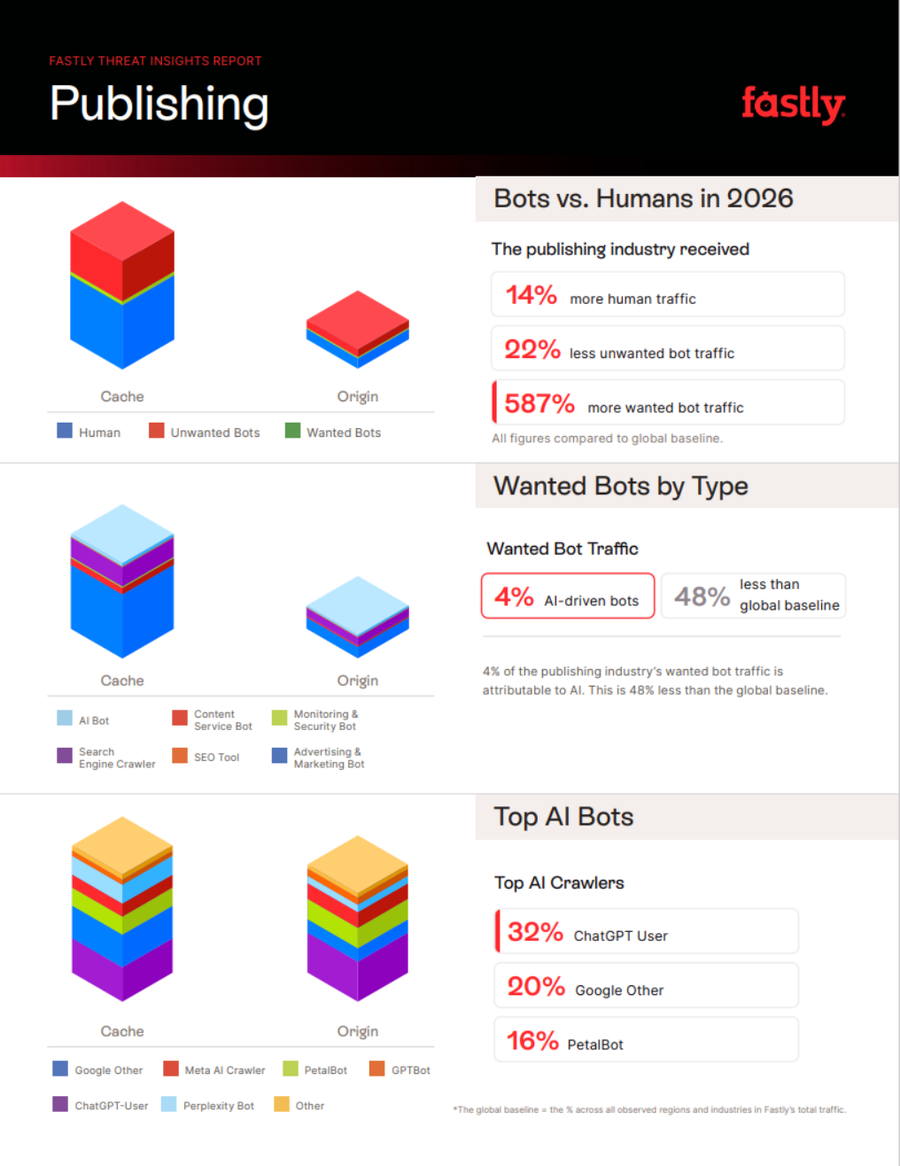
Le modèle économique de l’édition dépend souvent des revenus générés par les utilisateurs qui cliquent jusqu’à leurs domaines pour s’abonner afin de consulter le contenu, voir des publicités, etc., mais comme une part bien plus importante de leur contenu est récupérée, cela les oblige à reconsidérer ce que « voulu » signifie réellement pour leur activité.
Dans l’ensemble du réseau mondial de Fastly, les bots ont représenté 49 % de l’ensemble du trafic observé en janvier 2026. Bots également représentés :
47 % des requêtes vers le contenu du cache
60 % des requêtes atteignant l’infrastructure d’origine
Pour les éditeurs, ces chiffres ont un poids considérable.
Les entreprises de publication dépendent de relations directes avec leur audience. Le trafic génère des abonnements, de la publicité, des parrainages et de l'engagement. Mais les robots d’exploration et les extracteurs d’IA consomment de plus en plus le contenu des éditeurs sans garantir que les utilisateurs visitent un jour le site source.
Comme le souligne le rapport : « Une indexation du site d’un éditeur signifie que le contenu de valeur peut désormais être diffusé directement par un LLM, et les utilisateurs pourraient ne jamais accéder au site web source pour recueillir des informations. »
Cela change la définition du trafic « souhaité ».
Les éditeurs font face à une crise existentielle en ce qui concerne le trafic de bots souhaité, d’autant plus qu’ils en reçoivent 587 % de plus que la référence mondiale. Historiquement, les éditeurs ont fortement optimisé pour les bots souhaités, car l’indexation de recherche contribuait à améliorer la découvrabilité. Mais les systèmes d’IA fonctionnent différemment. Au lieu de simplement rediriger les utilisateurs vers la source, ils peuvent résumer et diffuser le contenu des éditeurs directement dans les réponses générées.
Les éditeurs sont confrontés à de nouveaux compromis en matière de visibilité de l’IA
Selon le rapport, les bots d’IA représentent actuellement environ 8 % du trafic de bots souhaité à l’échelle mondiale et 4 % du trafic de bots d’IA pour les éditeurs. Bien que le volume global reste encore relativement faible, l’impact stratégique est significatif.
Les extracteurs d’IA, qui récupèrent du contenu en réponse aux invites des utilisateurs, influencent directement le fait que les éditeurs apparaissent dans les réponses générées par l’IA. Cela crée un équilibre difficile :
Autorisez l’accès à l’IA et gagnez en visibilité dans les expériences d’IA émergentes
Restreindre l’accès à l’IA pour préserver le trafic direct et la propriété de l’audience
Aucune des deux options n’est simple.
Dans le même temps, les éditeurs subissent également une pression croissante autour de leur contenu à plus forte valeur. Près de la moitié du trafic en cache provient désormais de bots, ce qui signifie que le contenu le plus susceptible de générer de l’engagement : actualités de dernière minute, sujets tendance, etc., est lui aussi de plus en plus ingéré pour la récupération par l’IA.
Pour les éditeurs, cela signifie que le Bot Management n’est plus seulement une question de sécurité. Cela devient aussi un enjeu de stratégie de contenu et de monétisation.
Toutes les automatisations ne se valent pas
Le rapport a également révélé que 99 % de tout le trafic de bots dans le monde était classé comme « indésirable », mais les éditeurs en reçoivent 22 % de moins. Cela signifie moins de trafic d’automatisation invérifiable, de scrapers malveillants, d’usurpateurs d’identité, de scanners, d’outils d’abus d’identifiants et de trafic d’automatisation trompeur se faisant passer pour du trafic légitime.
Bien qu’une diminution du trafic de bots indésirable soit probablement une réalité bienvenue, sans visibilité granulaire, les organisations risquent de traiter de la même manière tout le trafic lié aux bots, en bloquant potentiellement un trafic bénéfique ou en autorisant une activité nuisible.
Pour les éditeurs , comprendre quels bots accèdent au contenu et pourquoi est essentiel.
Ce que les éditeurs peuvent faire maintenant
S’adapter au trafic piloté par l’IA ne consiste pas à choisir entre tout bloquer ou tout autoriser. Il s’agit d’élaborer une stratégie plus réfléchie en matière de visibilité, de contrôle, de monétisation et de protection.
Gagner en visibilité. Les organisations ont besoin d’informations sur : quels bots accèdent au contenu et ce qu’ils récupèrent, si le trafic atteint le cache ou l’origine, et quelles activités correspondent aux objectifs de l’entreprise.
Allez au-delà du blocage. Le trafic IA moderne nécessite des contrôle davantage conçus à cet effet que les approches traditionnelles d’autorisation/blocage. Une certaine automatisation peut créer des opportunités de visibilité et de revenus. Certains peuvent simplement engendrer des coûts et des risques.
Envisagez de monétiser le trafic IA: alors que les plateformes d’IA continuent de rechercher du contenu d’éditeur de haute qualité, les stratégies de monétisation sont de plus en plus envisagées. Les éditeurs disposant d’une forte visibilité et de solides contrôles de gouvernance seront les mieux placés pour décider comment l’accès à l’IA soutient leurs objectifs commerciaux.
Trompez les indésirables. Les capacités de Deception de Fastly sont conçues pour perturber l’automatisation malveillante en fournissant aux hacker des signaux trompeurs et en réduisant l’efficacité des abus automatisés.
Débloquez votre stratégie de bots
L’IA transforme rapidement la manière dont les informations sont découvertes et consommées en ligne, et les éditeurs sont au cœur de cette évolution. Les organisations les mieux placées pour ce qui vient ensuite ne se contenteront pas de tout bloquer : elles le gouverneront de manière stratégique.
Téléchargez le dernier Threat Insights Report de Fastly pour explorer l’évolution du paysage mondial des bots et découvrir comment ils redéfinissent le web