

Bénéficiez de toutes les fonctionnalités d’un CDN moderne : une scalabilité transparente, une sécurité intégrée, un contrôle par programmation et une visibilité totale.




Le secteur de l’e-commerce à l’ère de l’IA : la vague agentique a-t-elle frappé ?
Les bots IA inondent l’e-commerce. Découvrez comment faire évoluer votre stratégie de bots, du blocage à la gouvernance stratégique, à la visibilité et à la monétisation.



Le dernier Threat Insights Report de Fastly, « L’IA, les bots et l’avenir agentique du web », explique comment l’IA, les bots et l’automatisation transforment Internet. On y découvre que près de la moitié de toutes les requêtes Internet proviennent désormais de bots. L’un des enseignements les plus clairs du rapport est que chaque secteur d’activité vit l’IA différemment. Certains y voient une automatisation plus malveillante. D’autres font face à de nouveaux défis opérationnels et infrastructurels, car les robots légitimes comme l’IA modifient complètement leur modèle d’exploitation.
Mais pour l'e-commerce, l’IA n’est pas un autre changement de trafic ; elle pose des défis stratégiques et opérationnels. Les vendeurs doivent maintenant investir davantage dans des outils de détection et d’atténuation de bots pour protéger les performances du site, les stocks et l’intégrité des données. Dans le même temps, la présence d’un trafic automatisé peut fausser les indicateurs de conversion et les modèles d’attribution, conduisant à des décisions commerciales erronées.
C’est ce qui fait de l’e-commerce l’un des secteurs confrontés aux implications stratégiques les plus immédiates du trafic piloté par l’IA.
L’état des bots dans l’e-commerce
Les bots remodèlent de plus en plus le paysage de la vente en ligne : ils peuvent simuler le comportement des utilisateurs à l’échelle, qu’il s’agisse des consultations de pages produit ou de l’activité liée au panier, et sont souvent utilisés à des fins telles que le suivi des prix, la veille concurrentielle, la fraude publicitaire, et même la manipulation des analyses. Par conséquent, une part croissante du trafic sur les sites d’e-commerce ne représente plus de véritables parcours clients, ce qui fait que les entreprises ont plus de mal à mesurer précisément la demande, à optimiser les dépenses de marketing ou à interpréter le comportement des utilisateurs. Même les bots légitimes (ceux que les sites d’e-commerce VEULENT) ont des implications plus larges, que les entreprises doivent prendre en compte.
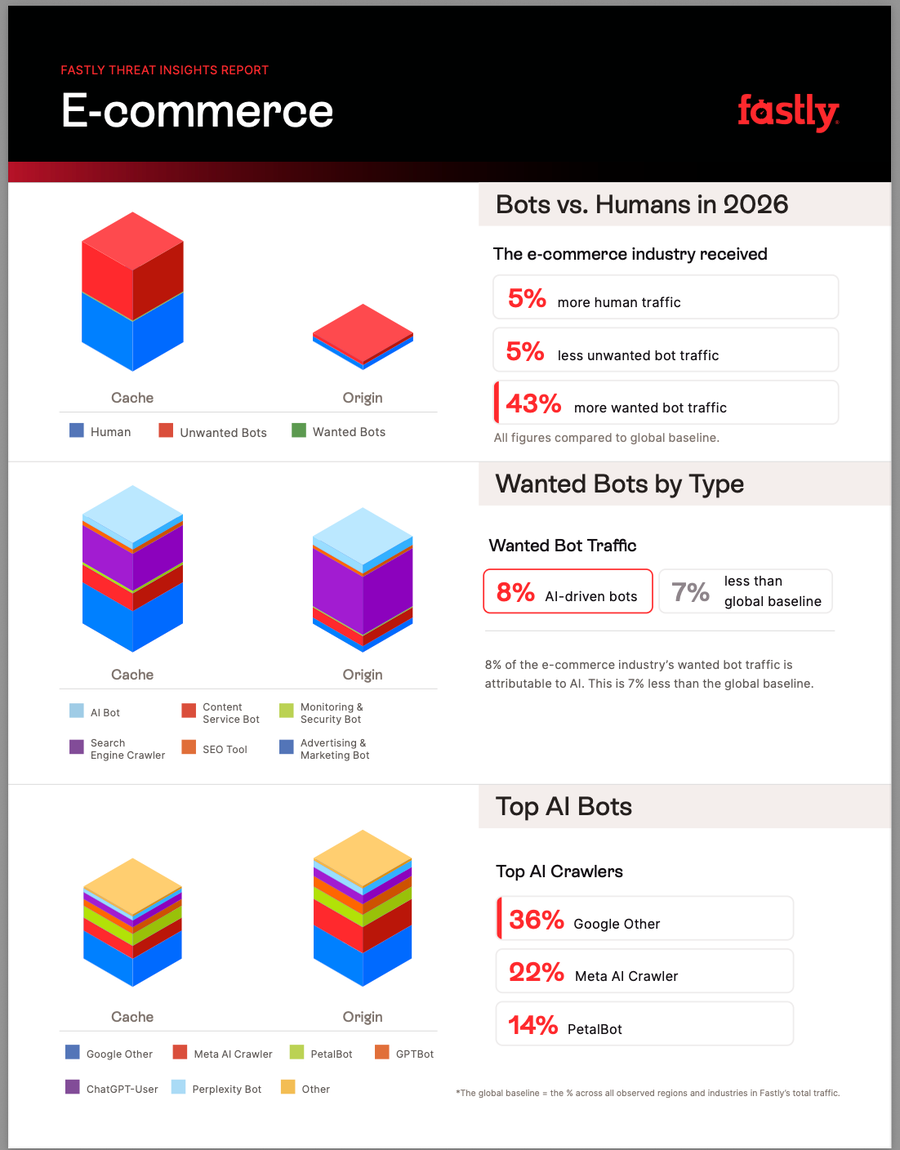
Les chiffres du rapport de ce trimestre montrent que l’e-commerce enregistre :
5 % de trafic humain en plus par rapport à la moyenne mondiale
5 % de trafic indésirable en moins par rapport la référence mondiale ;
43 % de trafic légitime en plus par rapport à la référence mondiale.
Que signifient donc ces chiffres ? Et quelles sont les implications du trafic généré par l’IA et les bots pour l’e-commerce de manière plus générale ? Nous donnons notre point de vue dans les sections suivantes.
Le paysage actuel de l’e-commerce
Les informations contextuelles suivantes permettent de mieux comprendre les conclusions du rapport et leurs implications pour les sites d’e-commerce.
Le défi de la fiabilité des données
Le trafic IA change fondamentalement l’e-commerce : au niveau le plus élémentaire, une part croissante des visites sur les sites, des consultations de produits et même de l’activité liée au panier n’est plus humaine. Les propriétaires de sites doivent être équipés pour gérer cela. Les bots d’IA analysent les catalogues de produits, surveillent les prix en temps réel, testent les flux de paiement et simulent les parcours utilisateurs à l’échelle. L’e-commerce passe ainsi d’un environnement purement axé sur le client à un environnement où l’automatisation introduit plus de complexité.
L’un des principaux impacts concerne la fiabilité des données. Dans l’e-commerce, les décisions ont longtemps été guidées par les signaux comportementaux (clics, temps passé sur une page ou taux de conversion). Comme une part importante de l’activité provient désormais de bots, ces signaux deviennent flous. Les équipes risquent de fonder l’optimisation sur des comportements qui ne reflètent pas la demande humaine, ce qui peut tout fausser, qu’il s’agisse du merchandising, des dépenses publicitaires ou des décisions commerciales globales.
Implications pour la concurrence
Le trafic IA accélère également la concurrence sur les prix et l’efficacité du marché. Les bots peuvent suivre la tarification des concurrents instantanément et en continu, afin de mettre en place des stratégies de tarification dynamique. Même si les consommateurs peuvent ainsi bénéficier de meilleures offres, cela comprime les marges et crée une boucle de rétroaction à grande vitesse où les avantages tarifaires sont de courte durée.
Risques pour la sécurité
Le changement concerne également les priorités en matière d’infrastructure et de sécurité. La gestion de volumes importants de trafic automatisé met à rude épreuve les performances du site et augmente les coûts (infrastructure, bande passante ou capacité de calcul). Les vendeurs doivent également se défendre contre des bots plus sophistiqués, comme les revendeurs à la sauvette ciblant les stocks limités, les bots extrayant des données propriétaires ou les campagnes de bourrage d’identifiants visant à exploiter les informations sauvegardées sur les comptes personnels. Cela a rendu la détection de bot, la limitation du débit et le filtrage du trafic essentiels.
L’e-commerce passe d’un environnement centré sur l’humain à un environnement où les entreprises doivent continuellement distinguer, se défendre contre et exploiter stratégiquement les interactions automatisées.
Constatations sur l’e-commerce au 1er trimestre
Avec ce contexte à l'esprit, plongeons dans les statistiques de ce trimestre.
1. Un plus grand nombre de robots légitimes entraîne un plus grand nombre de contraintes
Alors que le trafic évolue vers une répartition quasi-égale entre automatisé et humain, les 43 % de trafic légitime en plus constatés pour l’e-commerce par rapport à la référence mondiale de 1 % devraient alerter et inciter à une étude plus approfondie.
Ces 43 % sont-ils réellement légitimes ? Les entreprises disposent-elles des politiques et outils de gestion de bots nécessaires pour distinguer ce trafic soi-disant légitime du trafic indésirable ? Ont-elles mis en place une stratégie efficace pour définir les résultats commerciaux (positifs et négatifs) lorsque ce volume de trafic automatisé touche le site web ?
Même les bots légitimes (robots d’indexation des moteurs de recherche, etc.) peuvent exercer une pression à court terme sur l’infrastructure d’e-commerce lorsqu’ils opèrent à grande échelle. Contrairement aux humains, ces bots ne parcourent pas le site de manière occasionnelle ; ils explorent systématiquement de grandes parties de celui-ci, touchant souvent des milliers de pages en succession rapide. Cela peut augmenter la charge sur le serveur, accroître la consommation de bande passante et dégrader les performances du site pour les vrais clients, en particulier sur des périodes de pic de trafic.
Concernant les environnements e-commerce dynamiques où les stocks et les prix changent fréquemment, les bots peuvent demander les mêmes pages de manière répétée pour rester à jour, amplifiant encore la charge. L’e-commerce est également sujet à la forme de scraping plus « traditionnelle » de l’ère du SEO, où les robots d’exploration expérimentés privilégient ce type de contenu dans le cadre de leurs activités historiques et courantes : 36 % du trafic de bots vers les sites d’e-commerce provenait de Google.
Le défi, c’est que ce trafic légitime est souvent précieux ; il améliore la visibilité dans la recherche, alimente les outils de découverte IA et soutient des intégrations légitimes. Par conséquent, bloquer complètement ce trafic ne suffit pas. Les vendeurs doivent investir dans des outils et stratégies de gestion de bot sophistiqués les aidant à évaluer avec précision ce trafic afin de prendre des décisions éclairées sur le trafic qu’ils souhaitent réellement voir sur leurs sites.
2. Plus d’humains grâce au comportement humain
Avec 5 % de trafic humain en plus dans l’e-commerce par rapport à la référence mondiale de 51 %, les chiffres de ce trimestre montrent que les humains continuent à faire des achats en ligne. Dans bien d’autres secteurs d’activité, comme l’édition, la nouvelle « ère de l’IA » a transformé la façon dont les gens naviguent sur le web. Vous cherchez un article d’actualité ? Vous pouvez probablement obtenir des réponses à vos questions grâce au résumé de l’IA figurant en haut de votre page de recherche. Tous les secteurs fournissant des connaissances (données, actualités ou informations) constatent des impacts plus importants sur le trafic humain, car les utilisateurs n’ont plus besoin de cliquer sur les sites hôtes pour satisfaire leurs requêtes de recherche.
Nous émettons l’hypothèse que le volume plus élevé de trafic humain dans l’e-commerce reflète la nature des achats en ligne : les véritables utilisateurs humains apprécient toujours de parcourir le catalogue, ce que prouvent les chiffres de ce trimestre. Mais, 5 % étant un petit nombre, cela pourrait également simplement refléter la nature dynamique du trafic pendant notre analyse. Nous continuerons à surveiller cela et à en rendre compte au cours des prochains trimestres.
3. L’e-commerce est moins ciblé
Ce qui est peut-être le plus intéressant ce trimestre, c’est que l’e-commerce a enregistré 5 % de trafic indésirable en moins par rapport à la référence mondiale de 48 %. Cela signifie que les sites d’e-commerce ont enregistré moins de trafic non vérifiable, potentiellement malveillant ou douteux que le reste de notre échantillon.
Notre rapport du trimestre dernier s’est intéressé de près à l’automatisation headless, c’est-à-dire aux navigateurs automatisés entièrement fonctionnels utilisés pour imiter le comportement d’un utilisateur réel sur un site web, mais à la vitesse et à l’échelle d’une machine. L’e-commerce a enregistré le volume de trafic headless le plus élevé, à 45 % du total de notre dernier rapport. Cela est probablement en partie dû au fait que les sites d’e-commerce offrent aux hackers la possibilité de compromettre des comptes et de rechercher des données en temps réel sur les stocks et les prix afin de vendre moins cher et d’espionner les ventes, autant de choses qu’ils peuvent faire avec moins d’interférences de sécurité sous l’apparence d’un trafic légitime via des clients headless.
Il semble que l’e-commerce, bien qu’il soit légèrement mieux loti que les autres secteurs, reste une cible très propice aux activités malveillantes. Nous pensons que les 5 % enregistrés ce trimestre sont probablement le reflet de fluctuations générales, mais ne doivent pas être interprétés comme signifiant que les robots indésirables devraient recevoir moins d’attention. Même un petit nombre d’activités de bots malveillants peut avoir un impact disproportionné étant donné que c’était 5 % de plus que notre référence mondiale (48 % de bots indésirables dans tout le trafic mondial).
Ce que les vendeurs d’e-commerce peuvent faire maintenant
S’adapter au trafic piloté par l’IA ne consiste pas à choisir entre tout bloquer ou tout autoriser. Il s’agit de construire une stratégie plus délibérée autour de la visibilité, du contrôle, de la monétisation et de la protection.
Gagner en visibilité. Les entreprises ont besoin de savoir quels bots accèdent au contenu et ce qu’ils récupèrent, si le trafic atteint le cache ou l’origine et quelle activité est conforme aux objectifs commerciaux.
Allez au-delà du blocage. Le trafic IA moderne nécessite des mesures de contrôles plus ciblées que les approches traditionnelles d’autorisation/blocage. Certaines automatisations peuvent créer des opportunités de visibilité et de revenus. D’autres peuvent simplement engendrer des coûts et des risques.
Envisager de monétiser le trafic IA. Alors que les plateformes d’IA continuent de rechercher des contenus de haute qualité, les stratégies de monétisation sont de plus en plus envisagées. Les entreprises disposant d’une bonne visibilité et de contrôles de gouvernance efficaces seront les mieux placées pour décider de la manière dont l’accès à l’IA soutient leurs objectifs commerciaux.
Tromper le trafic indésirable. Les capacités Deception de Fastly sont conçues pour perturber l’automatisation malveillante en fournissant aux hackers des signaux trompeurs et en réduisant l’efficacité des abus automatisés.
Débloquez votre stratégie liée aux bots
L’IA change rapidement la façon dont les informations sont découvertes et consommées en ligne, et l’e-commerce est au cœur de ce changement. Les entreprises les mieux parées pour l’avenir ne se contenteront pas de tout bloquer ; elles régiront cela de manière stratégique.
Téléchargez le dernier Threat Insights Report de Fastly pour en savoir plus sur l’évolution du paysage mondial des bots et découvrir comment ils redéfinissent le web.