

Bénéficiez de toutes les fonctionnalités d’un CDN moderne : une scalabilité transparente, une sécurité intégrée, un contrôle par programmation et une visibilité totale.




La protection contre les bots est un minimum indispensable. Le trafic généré par des robots nécessite une stratégie commerciale
Face à l’explosion du trafic généré par l’IA, les entreprises ont besoin de bien plus qu’un simple système de blocage des bots. Découvrez comment distinguer les interactions utiles générées par l’IA des risques et élaborez une stratégie adaptée.


Comme l’a récemment indiqué mon collègue Hossein Lotfi dans son analyse approfondie de nos dernières données réseau, les requêtes d’IA sur notre plateforme ont augmenté environ 6,5 fois plus vite que le trafic généré par les utilisateurs. Le trafic autonome entre machines représentant désormais près de la moitié de l’ensemble des requêtes Internet, les entreprises se trouvent confrontées à un tout nouveau défi.
À mesure que le trafic lié à l’IA prend de l’importance, les entreprises doivent déterminer quelles interactions avec l’IA créent de la valeur, lesquelles comportent des risques, et comment réagir dans les deux cas. Bloquer les bots malveillants reste important, mais cela ne suffit plus. En l’absence d’une stratégie claire, la gestion de ce trafic automatisé constitue un défi commercial majeur. La plupart des entreprises ne sont pas en mesure de distinguer de manière fiable le trafic qu’il convient de bloquer de celui qui apporte une valeur ajoutée.
Bloquer ne représente que la moitié du travail
La plupart des entreprises ne sont pas prêtes à faire face à cette situation. Elles constatent une augmentation du trafic automatisé. Elles ressentent la pression qui s’exerce sur leurs applications, leurs API et leur infrastructure. Elles savent que des systèmes d’IA accèdent à leur contenu, mais elles ignorent souvent de quels systèmes il s’agit, pourquoi ils sont là, ce qu’ils font, ni si cette activité génère de la valeur.
La solution consiste-t-elle à bloquer tous les bots ? C’est une option tentante face à un afflux de requêtes inconnues. Il convient toutefois de bloquer certains types de trafic automatisé : les bots malveillants, le bourrage d’identifiants, le scraping agressif, le déni d’inventaire, les robots d’indexation qui enfreignent les règles et l’automatisation abusive constituent de réels risques.
Mais bloquer par défaut n’équivaut pas à disposer d’une stratégie complète. Considérer chaque requête automatisée comme une menace identique revient à réduire toute nuance à une réponse unique. Cela peut certes réduire certains risques, mais cela peut aussi bloquer de futurs clients, limiter la diffusion, nuire à l’expérience utilisateur et vous empêcher de comprendre comment les systèmes d’IA interagissent avec vos propriétés numériques.
Deux entreprises, deux approches différentes face au trafic IA
Le débat sur le trafic généré par l’IA se résume souvent à un choix entre l’autoriser ou le bloquer. Les décisions prises par les entreprises peuvent avoir un impact considérable sur leurs activités.
Prenons comme exemples concrets les deux grandes entreprises présentées dans les graphiques ci-dessous : l’une d’elles a constaté une forte hausse du trafic généré par les robots d’indexation et a mis en place une politique visant à les bloquer, très probablement pour préserver l’autorité de son contenu. La seconde a délibérément choisi de ne pas les bloquer et a, par conséquent, vu le volume de trafic généré par ces robots augmenter au fil des mois.
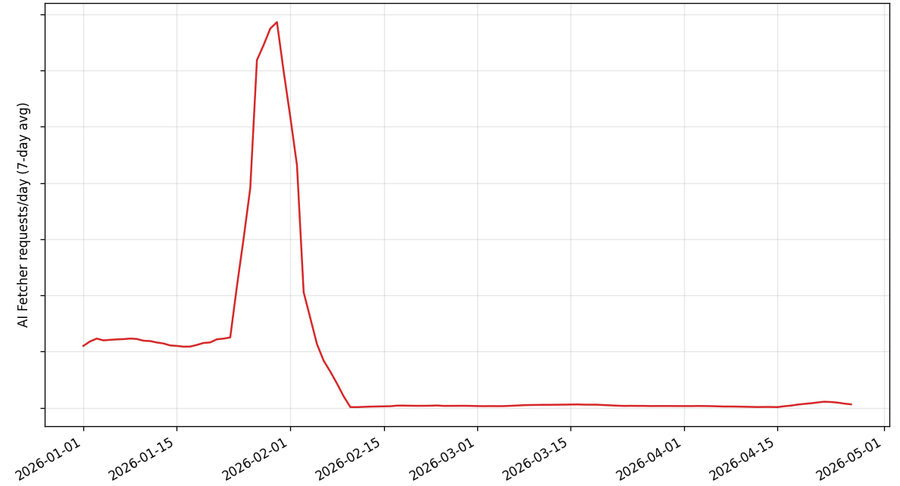
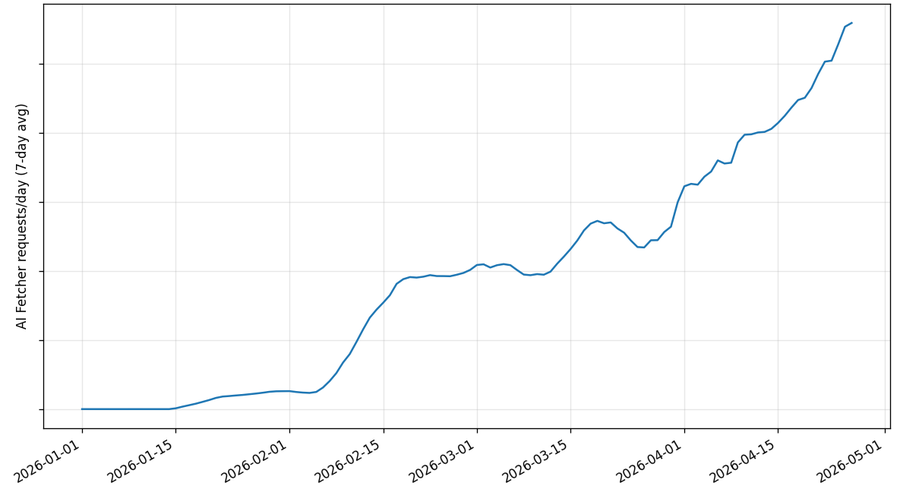
Les entreprises qui se contentent de bloquer le trafic généré par l’IA peuvent se sentir plus en sécurité à court terme. Mais elles risquent aussi de perdre toute visibilité dans cette nouvelle version d’Internet. Alors, que devriez-vous faire ?
C’est à la périphérie que se prennent les décisions
Le trafic humain et le trafic machine partagent désormais la même infrastructure, mais leur comportement est totalement différent. Alors que la périphérie constituait déjà le niveau de décision en temps réel pour les grandes entreprises numériques, cette évolution accélère cette tendance pour tous les autres acteurs. Comme elle se trouve au cœur de chaque requête, c’est à la périphérie que vous devez inspecter le trafic, appliquer les politiques, protéger les applications, accélérer la diffusion, gérer l’accès à la source et agir avant que les requêtes n’engendrent des coûts, des risques ou de la latence.
Pour que cela fonctionne, il faut faire preuve de clarté. Vous devez identifier les systèmes d’IA qui accèdent à vos ressources numériques, comprendre leur comportement et distinguer les automatisations utiles de celles qui sont indésirables. Avec une stratégie bien définie, vous n’avez pas à autoriser l’accès à toutes les machines ni à les bloquer systématiquement. L’objectif est de répondre à chaque requête en fonction de son intention précise et de son impact.
Élaborer une stratégie relative au trafic généré par les robots
Toute entreprise a besoin d’une stratégie fondée sur ses objectifs et ses priorités. Ce qui fonctionne pour une plateforme de voyage ne convient pas forcément à un éditeur. Les entreprises qui s’adaptent le mieux se concentrent sur trois axes essentiels : la visibilité, le contexte et la précision.
Gagnez en visibilité pour savoir précisément quelles machines interagissent avec vos sites, vos applications, vos API et votre contenu.
Déterminez le contexte concernant les ressources auxquelles ces systèmes accèdent, la fréquence de leurs requêtes, leur conformité aux politiques et leur capacité à générer de la valeur ajoutée pour l’entreprise.
Faites preuve de précision dans votre façon de réagir. Selon l’objectif du robot, vous pouvez choisir d’accélérer son fonctionnement, de l’interroger, de le rediriger vers un autre service, voire de réécrire sa réponse à la volée afin de lui fournir des données sur mesure.
Nous aidons nos clients à mettre en œuvre cette stratégie de gestion du trafic généré par les robots à la périphérie. À chaque étape du parcours d’une requête, Fastly fournit la visibilité, le contexte et la précision nécessaires pour concilier performances, sécurité, bot management et accès à l’origine grâce à des informations en temps réel. Nous aidons les entreprises à distinguer l’automatisation bénéfique des activités indésirables.
Internet n’est plus réservé aux seuls humains. Une partie du trafic généré par les robots présente des risques, tandis qu’une autre apporte de la valeur ajoutée. L’avenir appartient à ceux qui savent faire la distinction et agir en conséquence.
Créez une stratégie étendue de gestion du trafic machine grâce aux solutions d’IA de Fastly et gagnez en visibilité, sécurité, performances et contrôle.
Déclarations prospectives
Ces articles contiennent des déclarations « prospectives » qui reposent sur les convictions et les hypothèses de Fastly, ainsi que sur les informations dont dispose actuellement Fastly à la date de publication de ces articles. Les déclarations prospectives peuvent comporter des risques connus et inconnus, des incertitudes et d’autres facteurs susceptibles d’entraîner une différence significative entre les résultats, performances ou résultats réels et ceux exprimés ou sous-entendus dans ces déclarations. Ces déclarations comprennent, sans s’y limiter, celles concernant les prévisions relatives à la croissance future, à la vitesse et à la composition du trafic généré par l’IA et l’automatisation ; les taux d’adoption et l’ampleur des workloads agentiques et des assistants IA ; les modèles de comportement des robots d’indexation et des robots d’extraction IA ; les impacts des requêtes automatisées sur l’infrastructure web ; ainsi que les performances, les capacités et les attentes concernant l’expérience client avec les produits et services de Fastly, y compris Fastly Bot Management. Sauf si la loi l’exige, Fastly n’assume aucune obligation de mettre à jour publiquement ces déclarations prospectives, ni de mettre à jour les raisons pour lesquelles les résultats réels pourraient différer sensiblement de ceux anticipés dans les déclarations prospectives, même si de nouvelles informations devaient être disponibles à l’avenir. Les facteurs importants susceptibles d’entraîner un écart significatif entre nos résultats réels et ceux prévus sont détaillés de temps à autre dans les rapports que Fastly dépose auprès de la Securities and Exchange Commission (« SEC »), notamment dans notre rapport annuel sur le formulaire 10-K pour l’exercice clos le 31 décembre 2025 et dans nos rapports trimestriels sur le formulaire 10-Q. Des copies des rapports déposés auprès de la SEC sont publiées sur le site web de Fastly et peuvent être obtenues gratuitement auprès de Fastly.