

Ottieni tutto ciò di cui hai bisogno da una CDN moderna: dalla scalabilità senza sforzi alla sicurezza integrata, dal controllo programmabile alla visibilità completa.




Vibe Shift? Senior Developers Ship nearly 2.5x more AI Code than Junior Counterparts
Fastly’s survey shows senior developers trust gen AI tools enough to ship 2.5x more AI code, while juniors stick to traditional coding and caution.


Key Takeaways
Senior developers ship ~2.5× more AI-generated code than juniors (32% vs 13%)
AI feels faster, but research shows developers can take ~19% longer with it
Nearly 1 in 3 developers spend enough time fixing AI output to offset gains
Experience drives trust: senior devs are more confident using AI in production
AI boosts morale (~80% enjoy coding more), even if productivity gains are unclear
Most developers are aware of AI’s environmental impact
Bottom line: AI coding tools reshape developer workflows more than they improve raw productivity and experience determines who benefits most.
---
AI tools for coding have quickly become part of many developers' daily workflows. From GitHub Copilot and Claude to Gemini and other coding assistants, developers increasingly rely on AI to generate code, troubleshoot bugs, and accelerate development. At the same time, debates around "vibe coding" — the practice of relying heavily on AI-generated code without fully understanding every implementation detail — have raised questions about productivity, code quality, and security.
Fastly’s July 2025 survey of 791 developers set out to test those debates against real data.
Why Senior Developers Ship 2.5x More AI-Generated Code
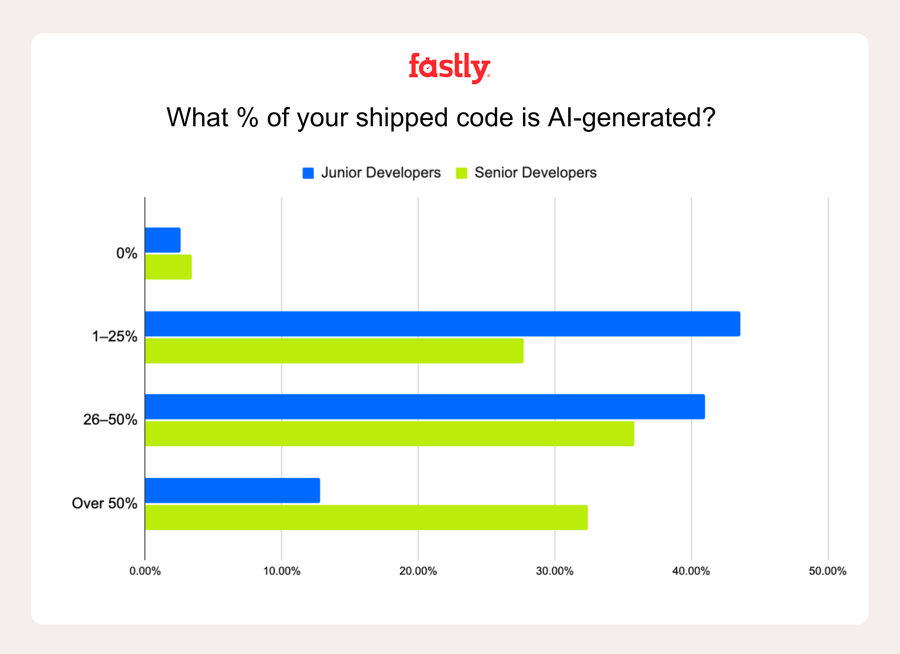
About a third of senior developers (10+ years of experience) say over half their shipped code is AI-generated, nearly two and a half times the rate reported by junior developers (0-2 years of experience), at 13%.
“AI will bench test code and find errors much faster than a human, repairing them seamlessly. This has been the case many times,” one senior developer said. A junior respondent noted the trade-offs: “It’s always hard when AI assumes what I’m doing and that’s not the case, so I have to go back and redo it myself.”
Senior developers were also more likely to say they invest time fixing AI-generated code. Just under 30% of seniors reported editing AI output enough to offset most of the time savings, compared to 17% of juniors. Even so, 59% of senior developers say AI tools help them ship faster overall, compared to 49% of juniors.
Senior Developers are More Optimistic about AI Saving Time
Just over 50% of junior developers say AI makes them moderately faster. By contrast, only 39% of more senior developers say the same. But senior developers are more likely to report significant speed gains: 26% say AI makes them a lot faster, double the 13% of junior developers who agree.
One reason for this gap may be that senior developers are simply better equipped to catch and correct AI’s mistakes. More experienced engineers may be better positioned to benefit from vibe coding because they can more quickly identify when AI-generated code is incorrect, insecure, or poorly suited to the problem being solved. They have the experience to recognize when code “looks right” but isn’t. That makes them more confident at using AI tools efficiently, even for high-stakes or business-critical code. By contrast, junior developers may not fully trust their ability to spot errors, which can make them more cautious about relying on AI, or more likely to avoid using it in production at all.
That tracks with how much AI-generated code actually makes it into production. Among junior devs, just 13% say over half of their shipped code is AI-generated. By contrast, 32% of senior developers say the same, suggesting that more experienced engineers are not only using AI more aggressively, but are also trusting it more in production environments. This is surprising given growing concerns about “vibe coding” introducing vulnerabilities into applications.
1 in 3 Developers Say Fixing AI Code Offsets the Time Savings
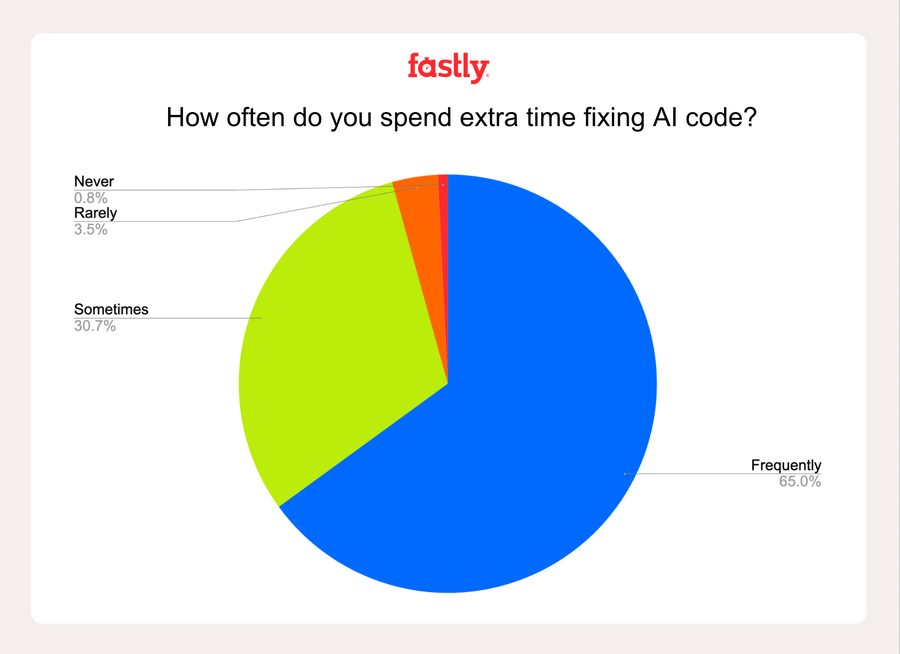
Discussions around vibe coding often focus on dramatic productivity gains, but our findings suggest the reality may be more nuanced. Nearly 1 in 3 developers (28%) say they frequently have to fix or edit AI-generated code enough that it offsets most of the time savings. Only 14% say they rarely need to make changes. And yet, over half of developers still feel faster with AI tools like Copilot, Gemini, or Claude.
Fastly’s survey isn’t alone in calling AI productivity gains into question. A recent randomized controlled trial (RCT) of experienced open-source developers found something even more striking: when developers used AI tools, they took 19% longer to complete their tasks.
This disconnect may come down to psychology. AI coding often feels smooth: code autocompletes with a few keystrokes. This gives the impression of momentum, but the early speed gains are often followed by cycles of editing, testing, and reworking that eat into any gains. This pattern is echoed both in conversations we've had with Fastly developers and in many of the comments we received in our survey.
One respondent put it this way: “An AI coding tool like GitHub Copilot greatly helps my workflow by suggesting code snippets and even entire functions. However, it once generated a complex algorithm that seemed correct but contained a subtle bug, leading to several hours of debugging.”
Another noted: “The AI tool saves time by using boilerplate code, but it also needs manual fixes for inefficiencies, which keep productivity in check.”
Nearly 80% of Developers Say AI Tools Make Coding More Enjoyable
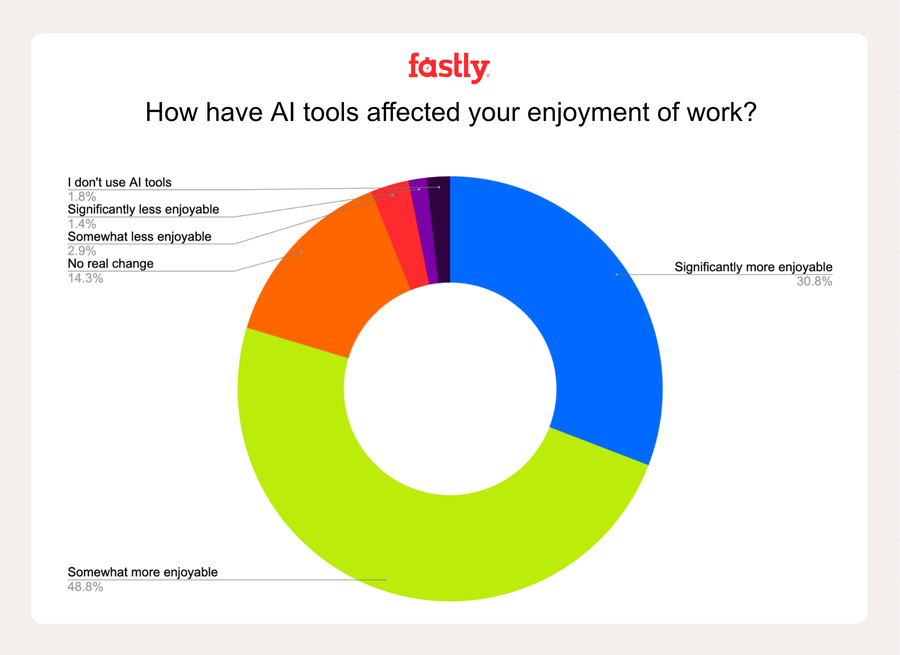
Productivity gains may be murky, but job satisfaction isn't: nearly 80% of developers say AI tools make coding more enjoyable. For some, it's about skipping grunt work. For others, it might be the dopamine rush of code on demand.
“It helps me complete a task that I’m stuck with. It allows me to find the answers necessary to finish the task,” one survey respondent says.
Enjoyment doesn’t equal efficiency, but in a profession wrestling with burnout and backlogs, that morale boost might still count for something.
Green Coding Awareness Rises Sharply with Experience
Fastly’s survey also explored developer awareness of green coding — the practice of writing energy-efficient software — and the energy cost behind AI coding tools. The practice of green coding goes up sharply with experience. Awareness climbs sharply with experience: just over 56% of junior developers say they actively consider energy use in their work, while nearly 80% among mid- and senior-level engineers consider this when coding.
Developers are broadly aware of the environmental cost of AI tools more generally: roughly two-thirds of developers across all experience levels said they know that these tools can carry a significant carbon footprint. Only a small minority (under 8% even at the most junior levels) were completely unaware.
What is vibe coding?
Vibe coding is a development style where programmers rely heavily on AI-generated code and natural-language prompts to build applications, reviewing, testing, and modifying the output rather than writing every line by hand. Supporters say it accelerates development and cuts repetitive work; critics warn that AI-generated code can introduce bugs, inefficiencies, or security vulnerabilities when developers trust it too - a tension this survey's data reflects directly.
Experience, Not AI Tools, Determines Coding Productivity
Senior developers ship more AI-generated code and spend more time fixing it, yet report the biggest speed gains and the most trust in AI for production work. Experience, not the tools themselves, appears to be what determines who actually benefits.
As AI coding tools become a standard part of software development, the question may be less about whether developers use them and more about how they use them.
Methodology
This survey was conducted by Fastly from July 10 to July 14, 2025, with 791 professional developers. All respondents confirm that writing or reviewing code is a core part of their job. The survey is distributed in the US and quality-controlled for accuracy, though, as with all self-reported data, some bias is possible.