

Ottieni tutto ciò di cui hai bisogno da una CDN moderna: dalla scalabilità senza sforzi alla sicurezza integrata, dal controllo programmabile alla visibilità completa.




Supporting Google Private AI Compute with Privacy-Preserving Edge Infrastructure
Learn how Fastly's privacy-preserving edge infrastructure supports Google Private AI Compute, enabling private and secure access to powerful Gemini models.


We’re pleased to share more details about Fastly’s work with Google in support of Private AI Compute.
As described in Google’s announcement, Private AI Compute is the next step in building private and helpful AI. The service is designed to enable users to access Google’s most capable Gemini models from the cloud with the same security and privacy assurances you expect from on-device processing. Google’s commitment to privacy by design and developing world-class security infrastructure closely aligns with how Fastly has approached internet infrastructure for more than a decade.
Fastly is proud to contribute privacy-preserving edge capabilities that help support the goals of Private AI Compute, building on a long history of technical collaboration with Google across performance, security, and privacy-enhancing technologies.
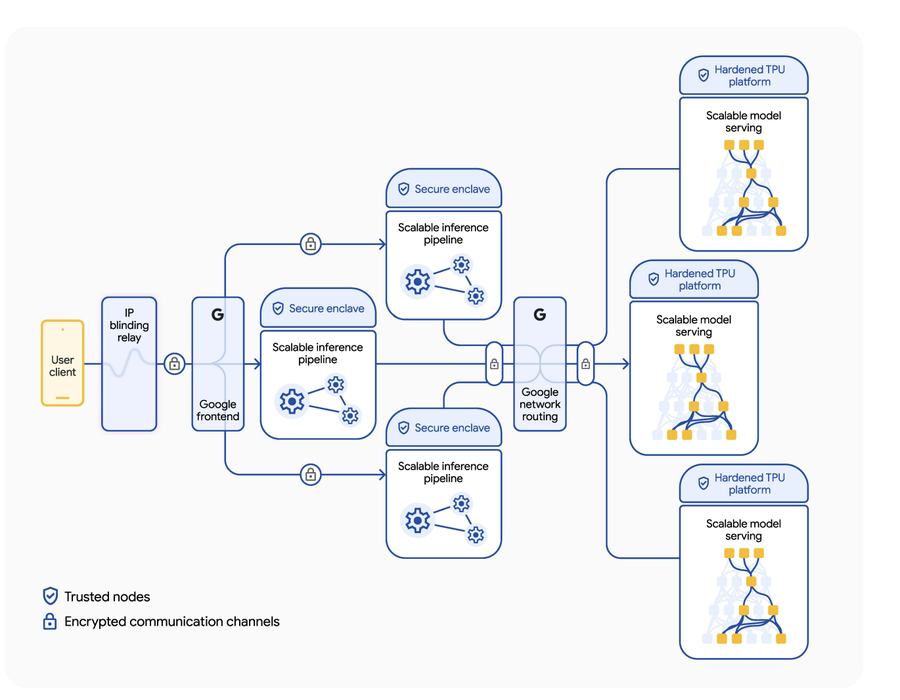
Private AI Compute: Google’s next step in building private and helpful AI
The Role of a Privacy-Preserving Intermediary
As part of this architecture, Google identified the need for independent intermediaries capable of facilitating encrypted, anonymized connections between user devices and private AI execution environments. The intermediaries are designed to operate under a double-blind model, where no single party has access to both identifying metadata and request content.
Key requirements for this layer include:
No access to user identity
No access to AI prompt, context, or response content
Inability to correlate requests across network hops
Low-latency performance suitable for interactive AI use
Global scale with edge proximity
Alignment with modern privacy standards such as OHTTP, encrypted DNS, and MASQUE
Fastly’s globally distributed edge platform supports these requirements and is used as part of Private AI Compute’s privacy-preserving request routing.
MASQUE and Privacy-Preserving Request Routing
MASQUE (Multiplexed Application Substrate over QUIC Encryption) is a modern proxying technology built on QUIC and HTTP/3 that enables encrypted, privacy-preserving traffic forwarding with minimal performance overhead.
In a MASQUE-based double-blind model:
The entry proxy does not have visibility into the destination or request content
The exit proxy does not have access to user identity or IP address
Request metadata exposure is intentionally minimized
Traffic benefits from low-latency, edge-optimized delivery
Within Private AI Compute, this approach helps support Google’s goal of allowing users and organizations to access advanced AI capabilities while limiting the exposure of sensitive data across the request lifecycle.
This work builds on prior collaboration between Fastly and Google around encrypted request routing, privacy-enhancing infrastructure, and performance-critical edge services.
Why Privacy-Preserving AI Infrastructure Matters
As AI adoption accelerates, organizations are increasingly looking for ways to deploy advanced models while meeting rising expectations from users, regulators, and internal governance teams. Across industries, there is a growing demand for:
Private access models rather than public AI endpoints
Cloud-based AI with local-like privacy guarantees
Encrypted, edge-aware architectures
Strong workload isolation and minimal data exposure
Network designs that separate identity from content
Fastly’s role as an independent infrastructure provider helps support architectures where privacy is enforced by design rather than policy alone.
We share a vision for an internet and an AI ecosystem that prioritizes privacy, security, and performance. Private AI Compute represents an important step in that direction, and we’re pleased to support its goals as part of our ongoing collaboration with Google.
A Longstanding Technical Collaboration
While Private AI Compute represents Fastly’s first public collaboration with Google focused specifically on AI workloads, it builds on more than a decade of work across multiple Google teams.
Examples include:
Privacy-Enhancing Technologies and Web Standards: Fastly has collaborated with Google on a range of privacy-focused initiatives, including work related to OHTTP relays, anonymized measurement, and privacy-preserving request handling across web and mobile ecosystems.
Fastly Log Streaming and Google BigQuery: Fastly was among the early platforms to support real-time log streaming into BigQuery, enabling customers to analyze CDN, security, and edge compute data using Google’s analytics platform.
Google Cloud Storage and Cloud-Native Integrations: Fastly has long supported Google Cloud Storage as an origin for CDN and edge workloads, helping customers build scalable, cloud-native applications on Google Cloud.
These efforts reflect a shared focus on performance, security, and privacy at internet scale.
A Quiet Question for AI Builders
As AI adoption accelerates, teams across industries are being asked to answer a simple, but increasingly consequential, question:
Does our architecture require users to trust us indefinitely, or does it make misuse structurally impossible?
For organizations ready to treat privacy as a core system property rather than an afterthought, this is the bar. Reach out to us if you’d like a privacy check-up.