

Get everything you need from a modern CDN — from effortless scale and built-in security to programmable control and full visibility.




Real-Time Without The Complexity: Fanout for Edge WebSockets & Pub/Sub
Deliver sub-second real-time experiences for chat, live auctions, IoT, and more. Fastly Fanout manages WebSockets, HTTP, and TLS connections, bringing real-time communications and pub/sub patterns to the edge. Connect to any client from one backend, build MQTT applications, offload WebSockets, or even orchestrate events across the web - all at Fastly scale.
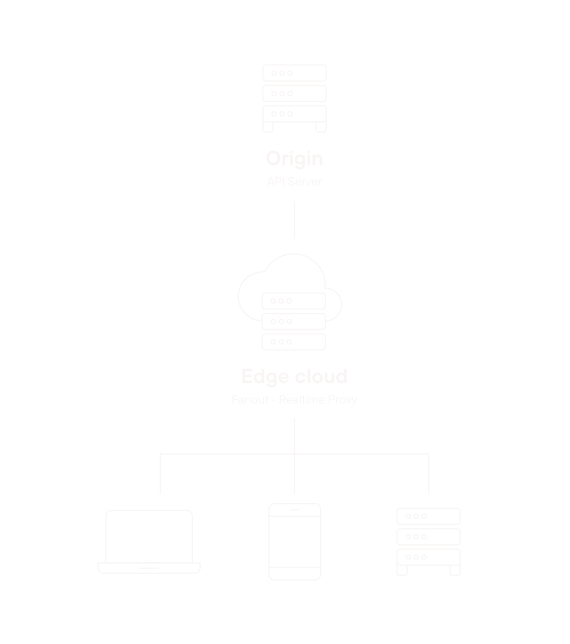
The Event-Driven Foundation for Modern Real-Time Apps
Leverage Fanout to manage the complexity of bi-directional communication, for everything from WebSockets to IoT sensor data. By handling connection state and protocol translation at the edge, you minimize origin load, ensure low-latency delivery, and increase your team's development speed.
Dramatically Reduce Origin Load and Infrastructure Costs
Fanout can manage millions of concurrent, stateful WebSocket or HTTP streaming connections at the edge, letting you relay simple HTTP requests to your origin. This can significantly offload server demand, drive system resilience, and deliver strong ROI.
Accelerate Developer Velocity and Time-to-Market
Build on a flexible platform that speaks WebSockets, HTTP, and TLS. Focus on business logic - not connection management - and build pub/sub, IoT, MQTT, and other real-time solutions.
Unify Real-Time Communication Across Protocols
With its strong HTTP/WebSockets foundation, Fanout lets services respond to requests from web traffic, WebSockets, or even inbound IoT data — and even translate between them. Fanout can manage connection state, coordinating with your origin via simple HTTP to offload resources and complexity.
WebSockets Pass-Through vs. Fanout: Choosing the Right Real-Time Strategy
Fastly's platform supports all real-time needs. Our pass-though WebSockets product provides a direct, bi-directional path through the CDN for self-managed infrastructures. Fanout is our event-driven solution for building more robust real-time applications, managing connection state, translating protocols, and dramatically offloading your origin. Use the information below to determine which solution best fits your use case.
WebSockets Pass-Through
Best for: Securing existing real-time data Infrastructure.
Primary connection model is 1:1, Bi-directional (Client to Origin)
Origin server manages all connection state.
No protocol translation. Requires origin to speak WebSockets.
Minimal origin offload & ROI. Origin must maintain concurrent connections.
Billing model = connection time.
Supports any use case that requires running your real-time data infrastructure at the origin.
Fanout (Push data at the edge)
Best for: Offloading the burden of operating real-time data infrastructure at the origin.
Primary connection model is 1:Many, Push/Pub-Sub (Event driven)
Fastly Fanout manages all connection state at the edge.
Fastly Fanout handles protocol translation. (e.g., WebSockets to Origin-friendly HTTP)
Maximum origin offload & ROI. Origin handles simple HTTP events and business logic.
Billing model = connection time and messages.
Provides real-time data at the edge for Live Auctions, Sports Scores, Stock Tickers, Real-Time Push Notifications, IoT Coordination (MQTT), Multi-User Chat.
Push Architecture Done Right
No need to build your own "stream server thing". We've done the hard work for you.
Hybrid reverse proxy and message broker.
Augment your existing API with push capability.
Designed for interoperability.
Any HTTP-based backend, including serverless/FaaS, can manage long-lived streams.
Self-hosted or cloud. It’s up to you.
Use our massive network with a custom domain name or run the software on your own servers.



"It would be challenging to accomplish what we're doing without Fastly. Edge computing is key to our technology."
Ryan Minor
Mobile and IoT Development Manager
Frequently Asked Questions
What is real-time communication and how does it work at the edge?
Real-time communication is the instantaneous data transfer between systems and users, bypassing the delays of traditional request-response cycles. Fastly enables this by moving connection management to the network edge, closer to the end-user. By maintaining persistent connections at the edge, Fastly’s push architecture eliminates the need for constant client polling, significantly reducing origin overhead and ensuring updates reach users with sub-millisecond latency.
How does Fastly support WebSockets and other real-time protocols?
Fastly supports WebSockets and other real-time protocols through two primary solutions: WebSockets Pass-Through and Fastly Fanout. WebSockets Pass-Through allows WebSocket connections to pass directly through the Fastly edge to a customer’s origin. The connection model is 1:1, bi-directional between the client and the origin. Fanout is an event-driven publish/subscribe (pub/sub) message broker integrated into the Fastly platform. The connection model is 1:many with Fastly managing all connection state at the edge. Fanout can translate between protocols at the edge converting stateful WebSocket, SSE, or Long-polling connections into stateless HTTP requests that an origin already understands.
Can Fastly be used as a message broker for real-time applications?
Yes. Fastly functions as a distributed message broker by leveraging a pub/sub (publish/subscribe) architecture at the edge. Developers can publish a single update and Fastly automatically fans that message out to all authorized subscribers instantly. This offloads the intensive work of message distribution from customers servers to our global network, providing a massive boost in concurrency limits and reliability.
What is pub/sub and why is it important for real-time systems?
Pub/Sub (Publish/Subscribe) is critical because it decouples the message sender from the receiver, allowing for a highly efficient, event-driven architecture. Instead of your server tracking every individual user connection, it simply sends one publish event to the edge. This reduces egress costs and prevents customer infrastructure from getting overloaded during high-traffic events.
How does Fastly handle MQTT workloads at the edge?
Fastly supports MQTT (Message Queuing Telemetry Transport) architectures by efficiently routing messages and maintaining persistent connections for IoT messaging. By leveraging Fastly’s edge network, developers can create, broker, and scale MQTT pub/sub messaging, connecting IoT devices to cloud services with low latency and high concurrency.
Is Fastly suitable for multi-user chat and collaboration apps?
Yes. Fastly is well suited for multi-user chat, live collaboration tools, and shared experiences that require constant updates. Using WebSockets and Fanout, messages can be delivered instantly. The platform ensures that as your user base scales from hundreds to millions, the real-time synchronization of your app remains consistent and performant.
What are the benefits of a push architecture compared to polling?
A push architecture is significantly more efficient than HTTP polling because it only sends data when an event actually occurs. Polling can create empty requests that waste CPU cycles and increase billing costs at the origin. By switching to a push model via Fanout, you reduce unnecessary network traffic, lower your infrastructure spend, and provide a better end-user experience.
How does Fastly scale real-time communication workloads?
Fastly’s edge network is built to handle large volumes of concurrent connections. Whether you are managing WebSockets, MQTT, or pub/sub messaging, the platform automatically distributes traffic across its infrastructure. This allows your real-time communication systems to scale without requiring manual intervention or complex capacity planning.
WebSockets & Fanout
Push real-time data to any devices, anywhere