


For 19 years, Verizon’s Data Breach Investigations Report (DBIR) has been a cornerstone of security research, tracking the industry’s most critical threats and trends. With AI reshaping the internet, Verizon partnered with Fastly this year to highlight the rise of AI-generated traffic and what it means for businesses in a portion of the report.
Want to get up to speed quickly? - hear key insights from DBIR co-author and Director of Threat Intelligence, Alex Pinto, in the quick video below.
The DBIR covers a massive range of security topics, leaving limited room to dive deep into any one area. While you’ll find highlights summarized in the report itself, below is the complete data and analysis Fastly provided to Verizon to provide a more extensive view into the growth and implications of AI bot traffic.
Opportunity or Existential Threat?
In the evolving era of agentic AI, products and standards can materialize in weeks, forcing entire markets, supply chains, and cybersecurity disciplines like AppSec to adapt just as quickly. Organizations must balance the pursuit of relevance and opportunity with the very real risk of disruption or disintermediation.
AI-generated traffic, more specifically crawlers and fetchers, are the emerging means for a variety of both legitimate and malicious actors to programmatically engage with companies across many touch points and channels. This increase in crawler and fetcher volume necessitates methods to actively manage bots, while striking the right balance across the needs for discoverability, relevance, and the critical mandate to secure an expanding attack surface.
AI-generated traffic is redefining how content is searched, recommended, and consumed: scraping content for training data and ingesting proprietary material into training sets without intellectual property rights, commercial, or legal agreement in place.
This raises two important questions:
How quickly is AI bot traffic growing?
Is AI bot traffic different for various verticals and industries?
Through our advanced AI bot management capabilities, Fastly was able to answer these questions in depth. We focused on measuring compound monthly growth rates (CMGR) across all sites and industries over an 8 month period in 2025, and the findings highlight that there is no one-size-fits-all approach to AI. The data makes it clear that organizations must establish balanced policies that adapt to their industry and individual traffic patterns.
Key Findings
Senior leaders across industries are navigating a rapid shift in how AI systems interact with their digital content. During the reporting period**, global traffic from AI crawlers and fetchers grew 21% month-over-month across all observed industries, signaling a structural change in how content and infrastructure are being accessed.
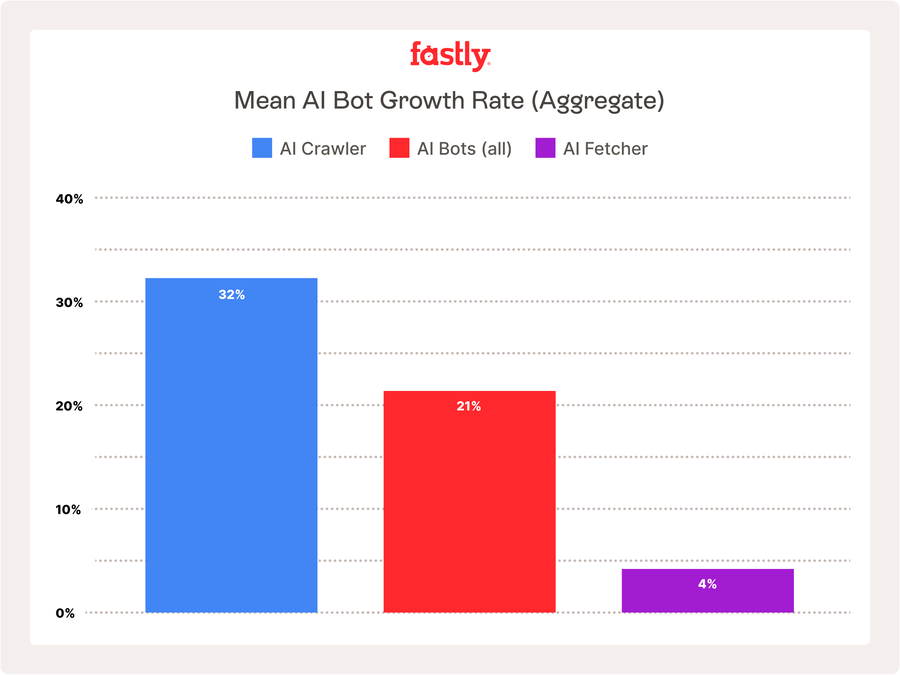
As organizations balance discoverability with revenue protection and infrastructure efficiency, the industry-specific data a layer deeper reveals three critical dynamics:
Online gambling accelerating fastest: The iGaming sector recorded the highest growth rate at 133%, demonstrating how quickly AI systems can begin consuming high-value, data-rich environments and the infrastructure resources that support them.
A perceived risk now validated: Digital media publishers and retail organizations, whose business models depend on direct traffic and engagement, rank among the top three industries for AI traffic growth. As more of their content is stored in these datasets, the findings reaffirm strategic considerations regarding content authority, attribution, and commercial impact.
Expansion beyond digital-native sectors: AI-driven retrieval is no longer concentrated in technology and historically content-rich industries. Manufacturing, Medical IT, and Real Estate all showed significant deviation from the global average, signaling that AI datasets are extending into industries not traditionally centered on AI strategy. This raises similar questions about disruption risk, data sovereignty, and access that digital-native sectors are currently navigating.
While these three critical dynamics stand apart from the rest, looking at a broad view of AI-generated traffic across industries reveals just how unique the challenge is for every organization.
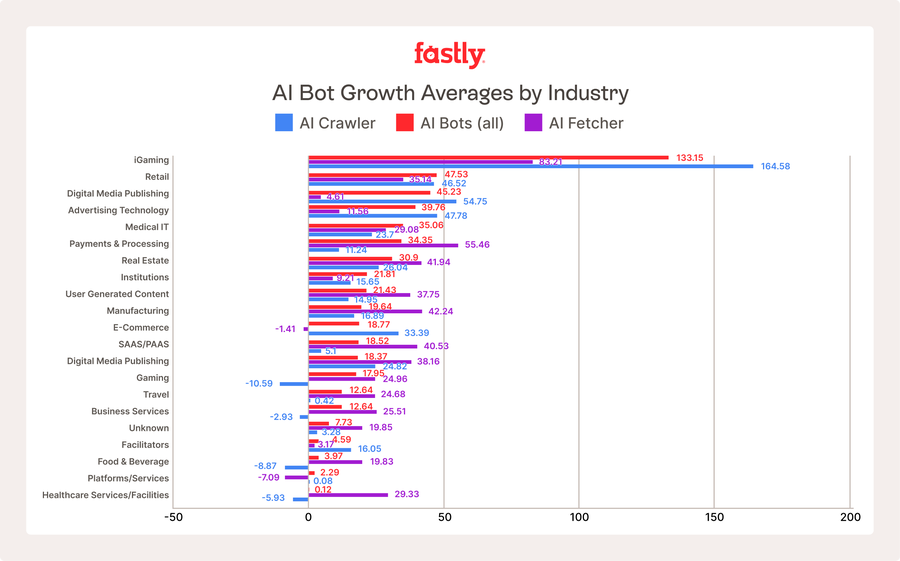
From this view, it’s clear that while the challenges of AI traffic are most pronounced in industries like iGaming and retail, even those with less traffic still face critical strategic challenges. Gaming, for example, observed a growth rate primarily driven by fetchers, implying that real queries for that data are occurring more frequently: those organizations must either optimize for crawler traffic via markdown, AEO, GEO best practices, or build strategy around how real-time requests for content are controlled.
To make assessment of AI in your industry easier, we’ve included a helpful table below that clearly articulates the CMGR for the array of industries charted above.
Industry | Average AI Bot Growth Rate | Average AI Fetcher Growth Rate | Average AI Crawler Growth Rate | Average Human Growth Rate |
|---|---|---|---|---|
(All Sites /Industries) | 20.81% | 4.40% | 32.29% | 0.29% |
iGaming | 133.15% | 83.21% | 164.58% | 22.99% |
Retail | 47.53% | 35.14% | 46.52% | 2.28% |
Digital Media Publishing | 45.23% | 4.81% | 54.75% | 0.18% |
Advertising Technology | 39.76% | 11.56% | 47.78% | 1.85% |
Medical IT | 35.06% | 29.08% | 23.7% | 8.70% |
Payments & Processing | 34.35% | 55.46% | 11.24% | -5.13% |
Real Estate | 30.9% | 41.94% | 26.04% | -7.41% |
Institutions | 21.81% | 9.21% | 15.65% | 1.52% |
User Generated Content | 21.43% | 37.75% | 14.95% | -1.53% |
Manufacturing | 19.64% | 42.24% | 16.89% | 2.20% |
E-Commerce | 18.77% | -1.41% | 33.39% | 0.27% |
SAAS / PAAS | 18.52% | 40.53% | 5.1% | 0.72% |
Digital Media Streaming | 18.37% | 38.16% | 24.82% | 1.70% |
Gaming | 17.95% | 24.96% | -10.59% | -7.20% |
Travel | 12.64% | 24.68% | 0.42% | 15.64% |
Business Services | 12.27% | 25.51% | -2.93% | 2.45% |
Facilitators | 4.59% | 3.17% | 16.05% | -7.73% |
Food & Beverage | 3.97% | 19.83% | -8.87% | -4.05% |
Platforms/ Services | 2.29% | -7.09% | 0.08% | 6.11% |
Healthcare Services/ Facilities | 0.12% | 29.33% | -5.93% | -2.92% |
Behind the Numbers: Top Industry Analysis
With the wide variance between industries, we took a deeper dive, providing speculation on the pronounced AI growth (or lack there of) in a few industries. You can use the following to begin considering the role and impact of AI in your space using the assessments below:
iGaming experienced the most pronounced growth of AI bot traffic at 133% CMGR, with both Crawler (165% CMGR) and fetcher (83% CMGR) showing significant increases. This pattern may reflect competitive intelligence gathering, odds aggregation, or training data collection for AI systems focused on probabilistic modeling.
Retail and Digital Media Publishing (48% CMGR and 45% CMGR, respectively) represented the second tier of highest growth industries. Publishing demonstrated crawler-dominant patterns (55% vs 5%), consistent with content harvesting behavior. Retail showed balanced growth across both bot types, suggesting multiple use cases like price monitoring, inventory tracking and product comparison.
E-Commerce showed AI bot growth at 19% CMGR, below the mean. Notably, AI fetcher traffic declined (-1% CMGR) while crawler traffic grew at 33% CMGR. This pattern divergence may indicate that AI generated summaries are satisfying user queries, without requiring fetcher bots to access data in real time to answer questions.
Payments & Processing showed fetcher dominant growth (55% vs 11%), likely due to the need for up-to-the-minute information on exchange rates, fee structures, compliance policies, and transaction status. Fetchers are designed to access these in real-time, unlike crawlers that may only update every few hours or even days.
Human Patterns
Against the backdrop of massive AI traffic growth in numerous industries, we also took a look at how human traffic is growing for comparison. The result: Human traffic growth remained essentially flat at 0.29% CMGR across all sites in our dataset. A step further, we found that seven industries demonstrated negative human traffic growth while simultaneously experiencing AI bot increases, including Real Estate (-7.41% human, +31% AI bot), Payments & Processing (-5.13% human, +34% AI bot).
This inverse correlation between human and AI-generated traffic could suggest potential substitution effects where AI bots are replacing the human visitors who would traditionally visit applications from a search engine. We explored the implications of this dynamic for the Publishing industry specifically in our threat insights report if you’d like to learn more.
What to do About AI Bot Traffic
The patterns we observed signal a structural shift in the AI era. AI traffic is accelerating rapidly, validating long-standing concerns in some industries, while potentially introducing new exposure in others. If AI bot growth is primarily driven by training data collection for large language models (AI Crawlers), growth rates may plateau. Alternatively, if growth is driven by agent activity (AI Fetchers), current rates may represent the beginning of a sustained trend toward AI Fetcher traffic growth.
The data makes one point clear: Every organization with digital content must deliberately define its AI traffic strategy. Adaptation is no longer optional, and these three points can guide how to get started:
Build with credible visibility as the foundation: Adaptation begins with trusted AI traffic intelligence. As malicious actors increasingly masquerade as AI crawlers, organizations must clearly distinguish between AI systems, traditional bots, and human users. Without clear visibility, any AI strategy is flawed from the start - based on incomplete or misinformed data. If getting first-party data isn’t a possibility at this time, Fastly’s latest security research report dove deep into the AI landscape in 2026 to provide an updated view into how it’s impacting businesses.
Define access with precision: Generative Engine Optimization (GEO) and Answer Engine Optimization (AEO) can bring brands to a new level of visibility, but may come at the cost of losing content authority and page impressions. Strategic plans must consider this tradeoff, and should include policies down to the level of the individual crawlers and fetchers on an individual site.
Move beyond binary control models: Traditional web application and API challenges have been met with a binary block/allow decisioning methodology that doesn’t work as cleanly with AI bot traffic. Bot Management vendors offer features like AI bot monetization, which provide new revenue streams, and actions like deception to combat the other bots that operate at scale on their apps and APIs.
Verizon + Fastly
As we look ahead, we’re already investigating insights that would be valuable for next year’s report. Verizon’s DBIR is a reminder to the cybersecurity community of how powerful we are when we join forces for the greater good. Combining insights from the biggest vendors in the world allows us to create reports that are truly representative of the macro threat landscape and can fuel strategies with representative insights. Thank you to Verizon for your partnership in this year’s report and we can’t wait to join forces again soon. Be sure to check out their report for a full download of their 2026 findings.